
A few years ago I published Standards For HEMA Testing – Everything You Ever Wanted To Know About Blade Flex, where I laid out a standard for flex testing blades that I felt struck the best balance between reducing error and ease of use. I had test data from quite a few feders in there, but not a massive population set.
Now I not only have some good population data, I also have some data from sharps!
Feders
How stiff is a feder? Well it really depends on how you design the feder. A modern training sword is made for us to play our game, much like historical training swords were designed to play their game. So there is no real ‘set point’ that defines a feder: any manufacturer is free to make them however stiff they wish, and the population of feders is going to reflect the market demand.
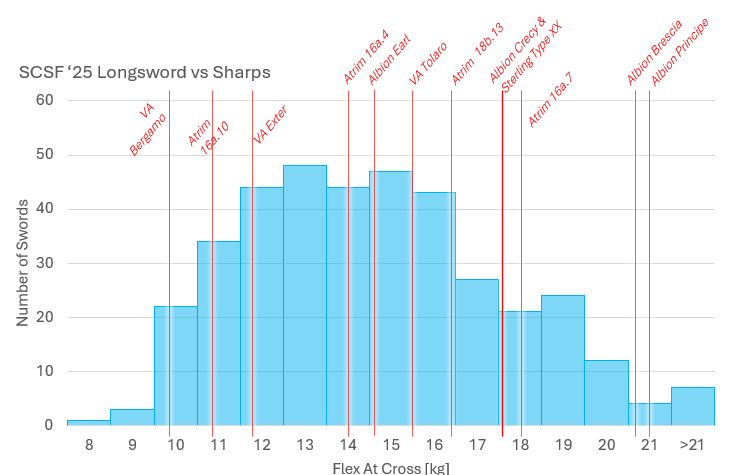
The following is data from 381 feders tested at SoCal Swordfight 2025. Note that the measurement was recorded even if a sword failed and was rejected from competition.
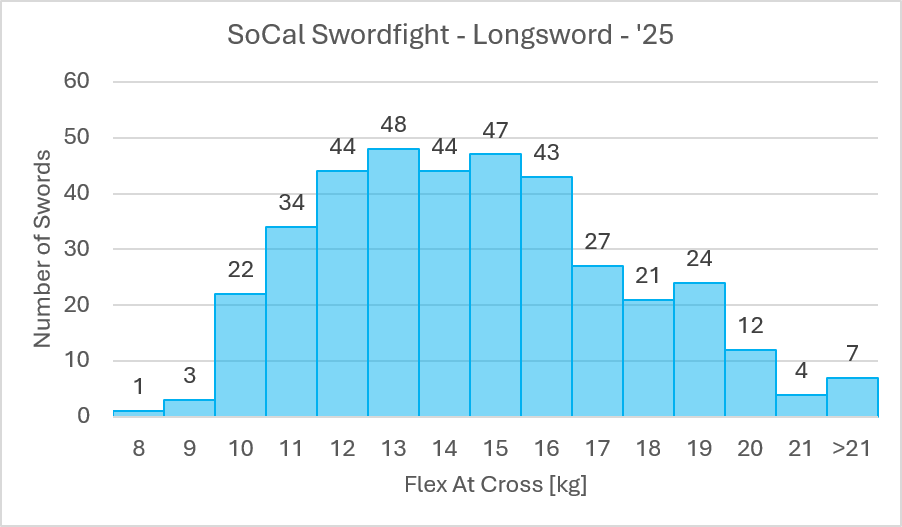
We can compare this with another event that took some very detailed data. The following is from the Wessex League 2024, which I made a quick histogram for.
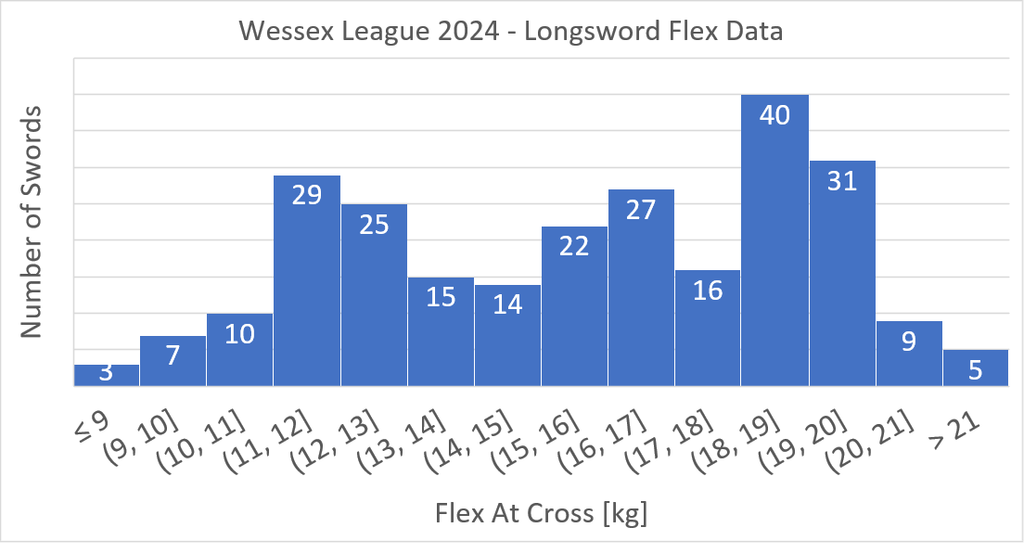
This is 254 swords, so a decent chunk. And we’re actually looking at a trimodal distribution rather than a bell curve, which is interesting all on its own. But it’s enough of a datapoint to show that the upper ranges on the SoCal data isn’t out to lunch.
(In recent years Wessex has been tightening up flex standards, so I expect that if we looked at 2026 data it would be much more towards the left. I’m going to assume it’s going to knock off at least one of the peaks and possibly make it more normal distribution like.)
Sharps
What really inspired me to write this article was RJ McKeehan going out and measuring the flex on a bunch of sharp swords.
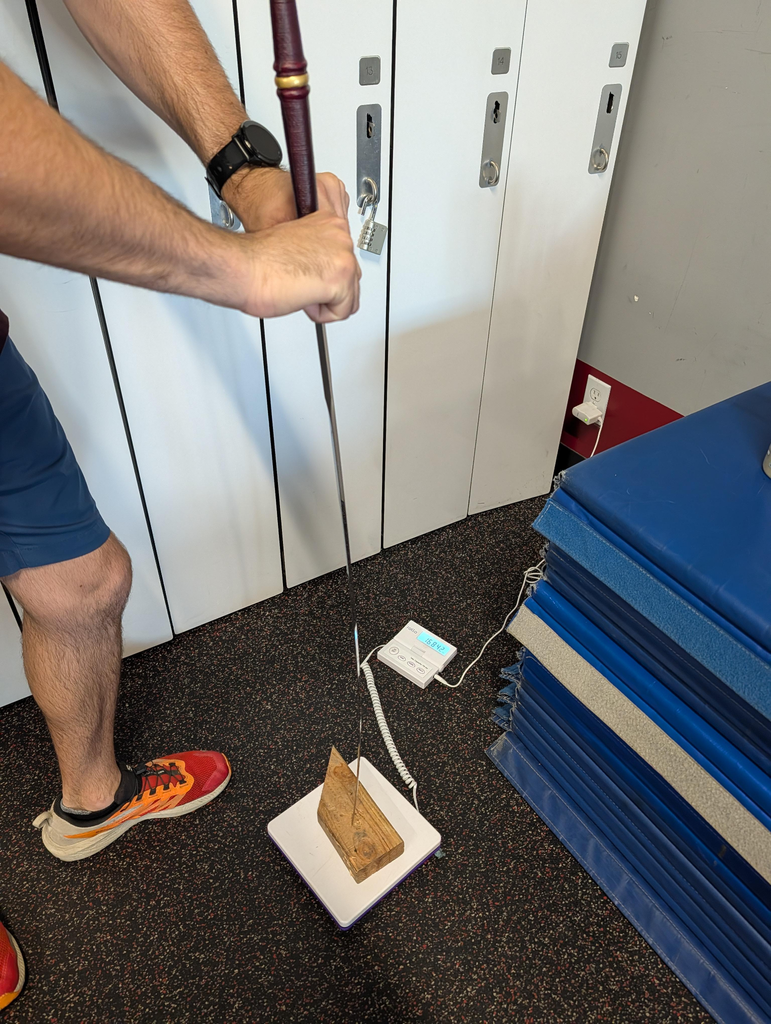
I will note that RJ is pushing the handle instead of pulling, like the test procedure dictates. But it turns out he has a pretty good reason:
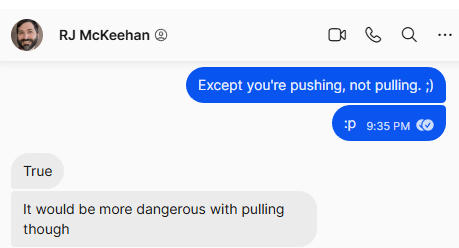
Which is fair, keeping your arms a little further away from the sharp blade is always a good thing. Pushing vs pulling seems to add about 0.2 kg of standard deviation to the measurement, so it’s not super consequential and shouldn’t move the needle much on these measurements.
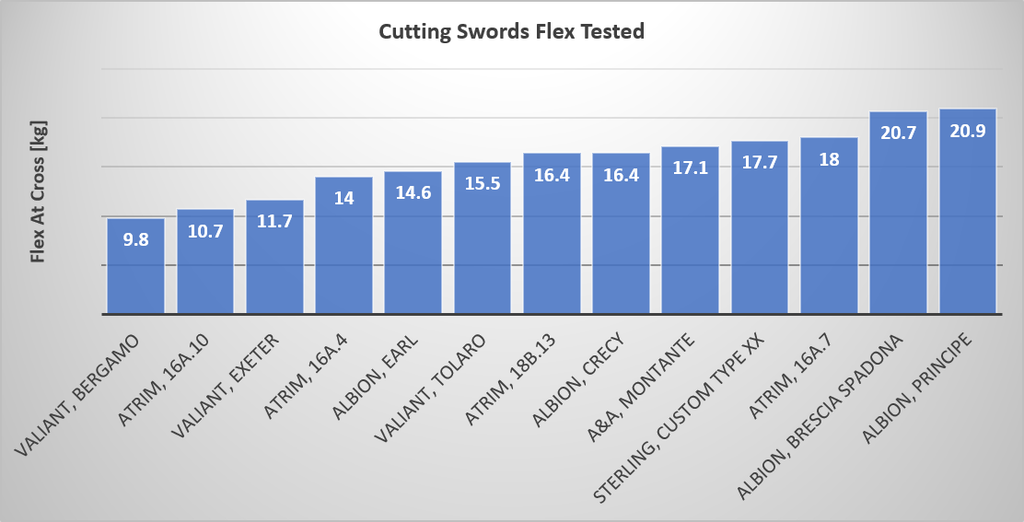
This is interesting, because most of these sharps actually fall into a valid range for competition. And some of the swords are actually quite a bit lower than some very flexible competition blades.
Sample Bias
If you haven’t started thinking about sample bias yet, you haven’t been paying attention. Because a lot of what we’re going to find here depends a lot on what you look at. We already saw a difference in the flex testing between the SoCal and Wessex data, and I imagine you’ll get big differences if you go to Slovakia, or travel back in time to a historical Longpoint or Swordfish competition. So this data is not really useful for some absolute sense of “how flexible is a feder” conversation. But it is usable for the “are sharps in the same ballpark” conversation.
The bigger issue comes when you start looking at the sharp data. The sharps measured are all blades that are used in HEMA cutting tournaments, so it’s going to skew because of two major sources of bias:
1) These are swords that modern manufacturers chose to make. Sword makers, even those doing very good historically accurate work, don’t make blades based on what was the most common. They make blades based on (a) what they like to make, and (b) what they think people want to buy.
2) These are swords that modern HEMA people want to cut with. Which is another form of selection bias that also skews the population a lot.
Conclusion
What does this prove? In terms of hard proof, all we’ve done is show that the most common swords used in competitive HEMA cutting are not qualitatively different in the flex department than the swords we use in sparring.
What we’ve also done is cast a lot of suspicion on the idea that modern feder stiffness is anathema to proper historical fencing. While at some point it definitely becomes a little silly, at first pass it looks like the modern sharps used would pass gear check at most HEMA tournaments. (Aside from the whole sharp thing. It really depends on if the staff has had their coffee yet I guess.)
So a lot more research is needed, particularly on the selection of sharp swords. But this was some cool data and I wanted to share.

Extra Stats For Nerds
I didn’t get into it here, but a lot of my flex testing relies on the assumption that the flex of the sword will follow a F = mx+b stiffness relationship. This is what I found when testing feders, but the blade profile of a sharp is different. So this shows that the onset of flexing happens at similar points, the actual behavior along the length of flex does need to be verified. And I’m in no rush to give one of my sharps a set doing such testing.
